Best Laptops For Construction Management in 2026
A construction laptop lives two lives. Half the week it sits in a site trailer or office running Procore, schedules, submittals and email. The other half it is out on an active floor, in dust, glare and weather, with a set of drawings open and a superintendent asking questions.
A thin office ultrabook fails the second half of that week, and a slow machine fails the first half, because modern construction software is heavier than most people expect.
Every laptop in this guide is a current 2025 or 2026 model chosen against that reality. Each one offers at least 16GB of memory, solid state storage, an anti-glare screen, and a chassis that has passed some form of durability testing.
Every specification was checked against the manufacturer’s own product pages or a full retailer specification listing, and the trade offs are stated honestly, including the two fully priced rugged machines that most buyers should not buy.
Read the guide in this order: decide how much ruggedness your sites actually demand first, because that choice splits the list in two. Then look at graphics, because Bluebeam and Procore ask for almost none while Revit and BIM coordination ask for a lot. Memory, screen brightness and battery follow from those two decisions.
One buying habit matters more than any single pick below: check the exact configuration before you pay. Workstations are sold in wide specification ranges under one model name, and a laptop with the right name but the entry graphics card or a dim screen is a different machine from the one reviewed here.
Wherever a configuration trap exists, the section names it. If your sites destroy ordinary laptops, our best rugged laptops in 2026 roundup compares the Toughbook 40, Getac B360 Pro and Dell Pro Rugged 14 on sealing, drop rating and battery life.
Quick Answer: The Lenovo ThinkPad P16 Gen 3 is the best laptop for construction management for most professionals in 2026. Its certified workstation graphics, four memory slots, huge battery and 800 nit anti-glare screen option cover everything from Bluebeam markup to full BIM coordination, in a chassis tested to military durability standards. Buy the HP ZBook Power 16 G11 if you want the same certified formula for less money, and the Panasonic Toughbook 40 if your sites destroy ordinary laptops.
How we picked: We started from the manufacturers own product pages, datasheets and PSREF documents for Lenovo, HP, Panasonic, Dell and ASUS, and cross checked the specifications against independent coverage from Notebookcheck, StorageReview, TechRadar and Laptop Media.
Every pick is a current 2025 or 2026 model, and no benchmark or battery figure is quoted beyond the manufacturers own ratings. Where a configuration trap exists, the section names it.
The Best Laptops For Construction Management at a Glance
| Model | Graphics | Display | Best For |
|---|---|---|---|
| Lenovo ThinkPad P16 Gen 3 | NVIDIA RTX PRO 2000 to 5000 Blackwell (8GB to 24GB) | 16 inch up to 3840 x 2400 IPS, 800 nits | Best overall |
| HP ZBook Power 16 G11 | NVIDIA RTX 500 to 3000 Ada (4GB to 8GB) | 16 inch 1920 x 1200 IPS, 400 nits | Certified value workstation |
| Panasonic Toughbook 40 Mk2 | Intel integrated (optional AMD module) | 14 inch 1920 x 1080 touch, 1200 nits | Fully rugged site work |
| Dell Pro Rugged 14 (RB14250) | Intel integrated or NVIDIA RTX 500 Ada | 14 inch 1920 x 1080, up to 1100 nits touch | Semi-rugged field work |
| Lenovo ThinkPad T14 Gen 6 | Intel / AMD integrated | 14 inch 1920 x 1200 IPS, up to 500 nits | Lightweight all-rounder |
| ASUS TUF Gaming A16 (2025) | NVIDIA RTX 5060 (8GB) | 16 inch 1920 x 1200, 165Hz, 300 nits | Best value performance |
1. Lenovo ThinkPad P16 Gen 3: Best Overall Laptop for Construction Management

The P16 Gen 3 takes the top spot because it is the one machine here that never makes you choose between office power and site toughness.
Intel Core Ultra HX processors with up to 24 cores handle estimating, scheduling and a dozen open applications without slowing down, and the NVIDIA RTX PRO Blackwell graphics options, from the 8GB RTX PRO 2000 up to the 24GB RTX PRO 5000, are certified by software vendors for the applications construction actually runs.
That certification is the quiet reason workstations exist: AutoCAD, Revit and Navisworks are tested against these drivers, so a model that opens cleanly on day one keeps opening cleanly after every update.
Memory and storage follow the same no-compromise pattern. Four memory slots accept up to 192GB of DDR5, so a sensible 32GB today can become 64GB when a project moves into heavy BIM coordination, and three SSD slots mean drawing sets, drone surveys and photo archives never fight for space.
It is the same workstation logic that puts its smaller relatives at the top of our guide to the best laptops for engineering students, scaled up for professional project loads.
The site half of the week is covered too. The display options include a 3840 x 2400 IPS panel at 800 nits with an anti-glare finish and full DCI-P3 color, bright enough to read drawings in a lit trailer or a shaded slab, plus a touch OLED option for markup work.
The 99.9Wh battery is the largest class of battery a laptop can carry, the aluminum chassis is tested to MIL-STD-810H durability standards, and the port set includes 2.5 gigabit Ethernet, Thunderbolt 5 and an SD Express card reader for camera and drone cards.
The costs are weight, about 2.54 kg before the power adapter, and a price that climbs steeply with the larger graphics cards, so confirm the exact GPU in any listing before you pay.
Pros
- ✓ Certified RTX PRO graphics options up to 24GB for Revit, Navisworks and BIM work
- ✓ Four memory slots up to 192GB and three SSD slots, unmatched in this guide
- ✓ 800 nit anti-glare display option and a 99.9Wh battery for long site days
- ✓ MIL-STD-810H tested chassis with Ethernet, Thunderbolt 5 and an SD card reader
Cons
- ✗ Heavy at about 2.54 kg, plus a large power adapter
- ✗ Top graphics configurations are expensive, and cheaper versions share the name
Check the latest price: Lenovo ThinkPad P16 Gen 3 on Amazon
Best for: professionals running full BIM coordination who need certified graphics and huge memory headroom. Not for: buyers who want a light laptop or a low price.
2. HP ZBook Power 16 G11: The Certified Workstation for Less
The ZBook Power 16 G11 is the sensible way to buy the workstation formula without paying flagship money.
It pairs Intel Core Ultra 7 or Ultra 9 H-series processors with NVIDIA RTX Ada Generation graphics, from the entry RTX 500 Ada up to the RTX 3000 Ada with 8GB of memory, on a platform HP certifies for professional CAD and BIM applications.
For the daily construction stack, that means Bluebeam Revu with several large plan sets open, AutoCAD in 2D and light 3D, Procore in the browser, and a Revit model for viewing and coordination, all on drivers the software vendors have tested.
The details suit a working site office. The keyboard is spill resistant with a drain hole underneath, so a knocked coffee cup is a cleanup instead of a repair bill.
Memory sits in two standard slots and grows to 64GB, storage is a fast PCIe Gen4 SSD, and the 83Wh battery covers a day of meetings and site walks with charge to spare.
The 16 inch anti-glare screen reaches 400 nits with full sRGB coverage, which reads clearly indoors and in a shaded trailer, and the port set keeps the things site work still uses: wired Ethernet, an SD card reader, HDMI and two Thunderbolt 4 ports, at a starting weight of 2.12 kg.
The honest limits are brightness and ceiling. Four hundred nits is a trailer screen, not a direct sunlight screen, so if your markup happens standing in the sun, look at the rugged picks below instead.
The RTX 3000 Ada is also the top of this line, and firms doing heavy rendering or very large federated models will outgrow it and should step up to the P16 class above.
AMD powered versions of the G11 are also sold, some with integrated graphics only, so check that the listing in front of you names a discrete RTX card.
It also behaves like a proper fleet machine, which matters once a firm buys five or fifty of them.
HP sells the ZBook line with three year warranties as standard in most configurations, the security stack includes a self healing BIOS and tamper detection, and a single Thunderbolt dock on the trailer desk turns it into a dual monitor workstation for estimating and scheduling days.
Nothing about it is exciting, and that is the point: it is the workstation a construction company can standardize on.
Pros
- ✓ ISV certified RTX Ada graphics and Core Ultra H processors at a mid range price
- ✓ Spill resistant keyboard with a drain hole, built for site office accidents
- ✓ Two memory slots up to 64GB, 83Wh battery and a full port set with Ethernet and SD
- ✓ Lighter than the flagship workstations at 2.12 kg
Cons
- ✗ 400 nit screen is for shade and indoors, not direct sunlight
- ✗ Top GPU option stops at 8GB, so heavy BIM firms will outgrow it
Check the latest price: HP ZBook Power 16 G11 on Amazon
Best for: firms that want certified workstation performance at a mid range price. Not for: markup work in direct sunlight or heavy rendering on very large models.
3. Panasonic Toughbook 40 Mk2: Fully Rugged for Sites That Break Laptops
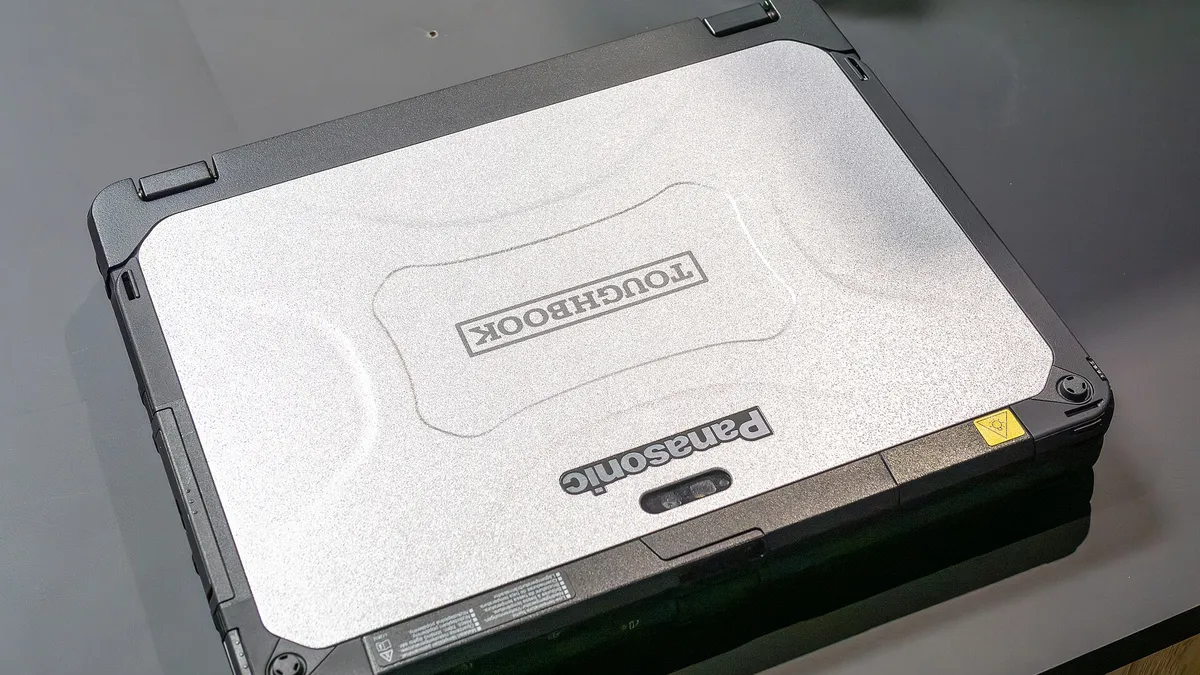
The Toughbook 40 exists for the jobs where laptops go to die: civil works, utilities, heavy industrial sites, anywhere with driving rain, blowing dust, vibration and drops onto concrete.
It is certified to MIL-STD-810H and sealed to IP66, which means dust tight and protected against powerful water jets, and it is drop tested from six feet. The magnesium alloy chassis has a carry handle, reinforced port covers and a raised bezel protecting the screen.
This is not a laptop you protect from the site; it is a laptop you take onto the site and stop thinking about.
The screen is the feature construction users will feel first. The 14 inch Full HD touchscreen reaches 1200 nits, the brightest panel in this guide, and it stays readable in direct sunlight while accepting input from gloves, a stylus or wet fingers, so plan markup and punch list photos keep working in the rain.
The touchpad is likewise designed to work with gloves on.
Underneath, Intel Core Ultra 5 or 7 vPro processors, 16GB to 64GB of user replaceable DDR5 memory and a quick release SSD cover Procore, Bluebeam and drawing sets comfortably, and Panasonic’s modular xPAK bays let you add a second battery, a second drive, card readers or legacy ports in the field.
Battery life is the other headline. Panasonic rates the standard battery at up to 12 hours under the MobileMark 2025 test, and an optional second battery roughly doubles that, with hot swapping that lets you change packs without shutting down mid task.
The costs are real: the Toughbook 40 starts at about 3.35 kg, graphics are integrated Intel unless you order the optional AMD dedicated module, and the price sits at the top of this guide. For an office based project manager it is money wasted.
For a field engineer whose last two laptops died on site, it is the cheapest option here.
Pros
- ✓ IP66 sealing and MIL-STD-810H certification, drop tested from six feet
- ✓ 1200 nit touchscreen that works with gloves and in rain, readable in direct sun
- ✓ Hot-swappable batteries and modular xPAK bays for drives, readers and ports
- ✓ User replaceable memory, SSD, keyboard and battery for a long service life
Cons
- ✗ Heavy at about 3.35 kg and the most expensive machine in this guide
- ✗ Standard graphics are integrated; the dedicated GPU is an optional module
Check the latest price: Panasonic Toughbook 40 on Amazon
Best for: field engineers on harsh civil, utility or industrial sites where drops and rain are routine. Not for: office based managers who do not need full rugged sealing.
4. Dell Pro Rugged 14: The Semi-Rugged Middle Ground
Most field laptops do not need to survive a six foot drop onto concrete. They need to survive a three foot drop off a tailgate, a splash of rain during an inspection, and a truck cab in August. The Dell Pro Rugged 14, model RB14250, is built exactly for that middle ground.
It carries a MIL-STD-810H certification with drop testing from three feet, an IP53 rating against dust and water spray, and an operating range from minus 29 to 63 degrees Celsius, in a machine that weighs about 2 kg and has a proper carry handle.
The screen choice is the one to get right. The base panel is a 400 nit non-touch display, but the option worth paying for is the 1100 nit glove capable touchscreen behind Gorilla Glass, which reads in direct sunlight and takes plan markups with a gloved hand.
Inside, Intel Core Ultra U-series processors with up to 64GB of DDR5 memory in two slots handle Bluebeam, Procore and office work easily, and the optional NVIDIA RTX 500 Ada graphics card adds just enough GPU for viewing BIM models and drone mapping output in the field.
Two hot-swappable batteries keep the machine running through a shift change or a long inspection day, and the SSD is accessible from the bottom panel for quick swaps.
Set expectations correctly and the compromises are fair. IP53 means splashes and spray, not jets of water or a drop in a puddle, so the Toughbook above is still the answer for genuinely wet work.
The RTX 500 Ada is an entry level professional card, fine for viewing and markup but not for authoring large models, and the U-series processors give up raw speed to the HX chips in the workstations. The screen is 14 inch Full HD only.
As a daily field machine for superintendents and field engineers, though, this balance of toughness, brightness and weight is the sweet spot of the rugged category.
Connectivity deserves a mention too, because field work happens where office networks do not. Dell offers optional 5G and dedicated GPS on this model, so drawings and daily logs sync from the site itself rather than back at the trailer, and vehicle docks are available for truck based crews.
The sealed keyboard options and a touchpad with physical buttons that work through gloves round out a machine that was clearly designed by people who have watched laptops fail outdoors.
Pros
- ✓ 1100 nit glove touch screen option, readable in direct sunlight
- ✓ Dual hot-swappable batteries for uninterrupted field days
- ✓ MIL-STD-810H and IP53 protection at about half the Toughbook’s weight
- ✓ Optional RTX 500 Ada graphics, rare in a semi-rugged laptop
Cons
- ✗ IP53 stops at splashes; it is not sealed against heavy rain or immersion
- ✗ U-series processors and entry GPU limit heavy BIM authoring
Check the latest price: Dell Pro Rugged 14 on Amazon
Best for: superintendents and field engineers who need a bright glove touch screen without full rugged weight. Not for: genuinely wet work or authoring large BIM models.
5. Lenovo ThinkPad T14 Gen 6: The Lightweight Durable All-Rounder

Plenty of construction managers split their week between a head office, a trailer and short site visits, and never need a rugged machine at all. They need a durable business laptop that shrugs off daily travel, and the ThinkPad T14 Gen 6 is the default answer.
It is tested to MIL-STD-810H standards, the keyboard is spill resistant, there is a built-in Ethernet port for trailer networks, and the whole machine starts at about 1.39 kg, light enough to carry around a site all day without thinking about it.
The specification fits the management workload honestly. Intel Core Ultra or AMD Ryzen AI PRO processors, memory in two slots that grows from 16GB to 64GB, and up to 2TB of storage cover Procore, Bluebeam with normal plan sets, estimating tools and the usual office stack without strain.
Choose the screen carefully: the low power panel option reaches 500 nits, which reads well in bright rooms and shaded outdoor spots, and is the version to order. The 57Wh battery handles a day of meetings and site walks, and ThinkPad support and parts availability are as good as business laptops get.
Site dust will still cake the screen and keyboard, so it is worth learning how to clean a laptop screen without streaks before the first deep clean with the wrong cloth.
The limits follow from the integrated graphics. There is no dedicated GPU on the mainstream configurations, so while 2D AutoCAD and plan review are fine, spinning a large Revit or Navisworks model will feel slow, and coordinators who live in 3D models should buy one of the workstations above instead.
The same soldered memory warning from the rest of the ThinkPad range applies too: the V-series versions fix memory at purchase up to 32GB, while the U and H series versions keep the two upgradeable slots this recommendation is based on.
Pros
- ✓ MIL-STD-810H tested and spill resistant, yet only about 1.39 kg
- ✓ Built-in Ethernet, two memory slots up to 64GB and strong battery life
- ✓ 500 nit low power screen option readable in bright conditions
- ✓ Business grade support, parts and security including TPM 2.0
Cons
- ✗ Integrated graphics only, so heavy 3D BIM work feels slow
- ✗ V-series versions have soldered memory; check the processor before buying
Check the latest price: Lenovo ThinkPad T14 Gen 6 on Amazon
Best for: construction managers splitting time between office, trailer and short site visits. Not for: coordinators who live in large 3D Revit or Navisworks models.
6. ASUS TUF Gaming A16 (2025): Best Value Performance
Not every construction laptop budget stretches to a certified workstation, and the TUF Gaming A16 is where the value is.
The FA608 pairs an AMD Ryzen 7 260 processor with an NVIDIA GeForce RTX 5060 graphics card with 8GB of memory, running at up to 115 watts, which is more graphics power than the entry workstation cards above at a lower price.
Revit, AutoCAD 3D, SketchUp and Bluebeam all run comfortably on it, memory comes in two slots upgradable to 64GB, there are two SSD slots, and the 90Wh battery is genuinely large for a machine of this performance.
The TUF name is not just marketing. ASUS tests this line to MIL-STD-810H durability standards, so the chassis has passed drop, vibration and temperature testing that most consumer laptops never see, and there is a built-in Ethernet port for the trailer.
The 16 inch anti-glare screen runs at 165Hz with full sRGB coverage, which makes panning around a drawing set feel fluid.
It is the grown up version of the trick contractors have used for years, buying gaming hardware for work software, and readers comparing cheaper options should see what the same approach buys at the bottom of the market in our guide to the best gaming laptops under $500.
The trade offs are the honest ones for a gaming machine at work. The standard screen is 300 nits, fine in a trailer but washed out in direct sun, so outdoor markup belongs to the brighter picks above.
There is no ISV certification, which means CAD vendors have not tested these GeForce drivers the way they test the RTX PRO and Ada cards, and most shelf configurations ship with Windows 11 Home, which some company networks will ask you to upgrade. The styling is gamer flavored, RGB keyboard included.
None of that stops it being the most construction performance per dollar in this guide.
Pros
- ✓ RTX 5060 graphics power at a price below entry certified workstations
- ✓ MIL-STD-810H tested chassis, unusual at this price
- ✓ Two memory slots to 64GB, two SSD slots and a big 90Wh battery
- ✓ Built-in Ethernet and a fast, fluid 165Hz anti-glare screen
Cons
- ✗ 300 nit standard screen washes out in direct sunlight
- ✗ No ISV certification, and most retail units ship with Windows 11 Home
Check the latest price: ASUS TUF Gaming A16 (2025) on Amazon
Best for: buyers who want the most construction performance per dollar. Not for: outdoor markup in direct sun or firms that need ISV certified drivers.
How to Choose a Laptop for Construction Management
How much RAM does construction software need?
Treat 16GB as the floor and 32GB as the working target. A normal management day, Procore and email in the browser, a Bluebeam session with two or three plan sets, a spreadsheet estimate and a Teams call, fits in 16GB but leaves little headroom, and the machine will feel it by the second year.
With 32GB that same day is effortless, and a Revit or Navisworks model can open beside it. Step up to 64GB if BIM coordination is the job itself, with federated models from several trades open at once.
Whatever you buy, slotted memory that can grow later is worth real money in this category, because project software gets heavier every year while the laptop is expected to last four or five.
Do you need a dedicated GPU for Bluebeam and AutoCAD?
For Bluebeam Revu and 2D AutoCAD, no. Both are mostly processor and memory workloads, and modern integrated graphics drive them fine, which is why the lighter picks in this guide work.
A dedicated graphics card earns its place the moment 3D enters the day: orbiting a Revit model, running clash detection views in Navisworks, walkthrough renders, and drone photogrammetry output all lean on the GPU and its memory, where 8GB is the sensible size to aim for.
If that work grows into training models or heavy point cloud processing, the hardware logic changes again, and our guide to the best laptops for machine learning covers the top end of it.
Between the two, an ISV certified professional card is the safer buy for production CAD work, while a GeForce card gives more raw speed for the money.
Rugged laptop or regular business laptop for site work?
Match the machine to where it actually spends its hours.
If the laptop lives in an office and a trailer, comes out for walkthroughs, and rides home in a truck cab, a MIL-STD tested business laptop or workstation in a decent case is enough, and it will be lighter, faster and cheaper than a rugged machine.
If the laptop lives outdoors, on tailgates, scissor lifts and inspection rounds, in rain and concrete dust, buy the semi-rugged Dell.
If it works in civil, utility or heavy industrial sites where drops and water are routine, the fully rugged Toughbook stops being expensive the first time it survives a fall that would have written off a normal laptop mid project, along with the drawings and records on it.
If your day is mostly hands on site work rather than project management, see our guide to the best options for contractors working outdoors.
Mac or Windows for construction management?
Windows, and it is not close. Bluebeam Revu, the markup tool the industry standardized on, is a Windows application with no current Mac version. Revit is Windows only, Navisworks is Windows only, and most estimating and scheduling tools assume Windows as well.
Procore and the other web platforms run in any browser, and AutoCAD does have a Mac version, but it differs from the Windows release and plugs into fewer of the tools around it. A project manager who lives entirely in Procore, email and PDFs can work happily on a Mac.
The moment drawings, models or markup enter the job, a Windows laptop from this guide removes a whole category of workarounds.
Construction Laptop Terms That Actually Matter
Spec sheets for site laptops are full of ratings and certifications that decide whether a machine survives your project. These are the ones worth understanding, in plain language.
MIL-STD durability ratings. MIL-STD-810H is a US military test suite covering drops, vibration, dust, humidity and temperature extremes.
Passing it means the laptop survived a defined set of lab tests, which is a real signal of toughness, but brands choose which tests to run and how strictly, so it is a floor rather than a guarantee. A business laptop with MIL-STD testing will handle knocks, truck rides and trailer life well.
It is not the same thing as a rugged machine, where the rating is paired with sealed ports, reinforced corners and drop testing from greater heights.
Screen brightness in nits. A nit is one unit of screen brightness, and it decides whether you can read a drawing where you are standing. Around 300 nits is fine in an office. Four hundred to 500 nits works in bright rooms and shaded outdoor spots.
For direct sunlight you want 1000 nits or more, which is why the rugged picks in this guide cost what they do.
Brightness is only half the story, though: an anti-glare finish matters almost as much, because a glossy 600 nit screen reflecting the sky can be harder to read than a matte 400 nit one.
ISV certification. ISV stands for independent software vendor. Certification means the software maker, Autodesk for AutoCAD and Revit, Bentley, Trimble and others, has tested a specific graphics card and driver combination with their application and agreed to support it.
In practice it buys stability: certified drivers are the ones the vendor reproduces problems against, so crashes get fixed instead of shrugged at. It is the main reason professional RTX cards cost more than GeForce cards with similar speed on paper, and for firms running production BIM work it is usually worth paying for.
Ingress protection IP ratings. The IP code has two digits. The first rates dust protection, from 0 to 6, where 6 means completely dust tight. The second rates water, from 0 to 9, where 3 means spray, 5 means jets and 6 means powerful jets.
So IP53, on the semi-rugged Dell, shrugs off dust and rain spray, while IP66, on the Toughbook, is sealed against dust and hose level water. Ordinary laptops carry no IP rating at all, which is worth remembering before one spends a rainy season in a site truck.
Hot-swappable batteries. A hot-swappable battery can be removed and replaced while the laptop keeps running, usually because a small built-in bridge battery or a second battery bay keeps power flowing for the seconds the swap takes.
On a site that means the workday ends when you decide, not when the battery does: swap in a fresh pack at hour eight and keep inspecting. It is also a fleet feature, because a shared pool of charged spares in the trailer keeps every field laptop alive without a wall of chargers.
Frequently Asked Questions
What is the best laptop for construction management overall?
For most professionals, the Lenovo ThinkPad P16 Gen 3. It combines certified workstation graphics, four memory slots, a 99.9Wh battery and an 800 nit screen option in a durability tested chassis, which covers the full construction stack from Bluebeam to BIM coordination. Firms on a tighter budget should take the HP ZBook Power 16 G11, and field staff on harsh sites should look at the two rugged picks instead.
How much storage do construction managers need?
Start at 512GB and prefer 1TB. Drawing sets, specifications and submittals are not huge, but project photos, drone footage and local model files accumulate fast, and a nearly full drive slows everything else down. If you archive completed projects to company storage regularly, 512GB is workable; if the laptop is your filing cabinet, buy the terabyte.
Do I need a touchscreen for plan markup?
It helps, but it is not essential. Marking up drawings in Bluebeam with a finger or stylus on a touchscreen is faster on site than a touchpad, and the rugged picks in this guide are built around glove capable touchscreens for exactly that reason. In the office most people still prefer a mouse. Treat touch as a strong bonus on a field machine, not a requirement on an office one.
Can a regular laptop survive on a construction site?
A durability tested business laptop in a protective case survives trailer and office based site work for years, and most do. What kills ordinary laptops is direct exposure: concrete dust in the fans and keyboard, rain during inspections, and drops onto hard surfaces. If the laptop regularly leaves the trailer, the semi-rugged and rugged machines exist precisely because regular laptops fail those days.
Is a gaming laptop good for construction work?
For raw performance, yes. A gaming laptop offers a strong processor and graphics card for less money than a workstation, and it runs AutoCAD, Revit and Bluebeam well. What you give up is the certified drivers, the durability testing, the bright screen options and the business support, which is why the TUF Gaming A16 in this guide is the value pick rather than the top pick, and why firms doing production BIM work usually buy the certified machines.
The Verdict
Construction laptops are decided by where they work, not just what they run.
Buy the Lenovo ThinkPad P16 Gen 3 for the best all round mix of certified power, memory headroom and screen brightness, the HP ZBook Power 16 G11 for the same formula on a smaller budget, or the ASUS TUF Gaming A16 if raw performance per dollar leads.
Take the ThinkPad T14 Gen 6 if the job is management rather than models. And if the site itself is the threat, the Dell Pro Rugged 14 and the Panasonic Toughbook 40 are the two honest answers, at two different levels of punishment.
Confirm the exact graphics card, memory and screen in any listing before you buy, because the same model name covers very different machines, and check the latest price at the links above.