How Much RAM Do I Need for Gaming?
Ask a group of gamers how much RAM you need and you will get a different answer from each of them. One will say 8GB is plenty. Another will insist that anything under 32GB is a waste of a good graphics card. A third will tell you that RAM speed matters more than RAM size.
They are all partly right, and that is exactly why the question is so confusing.
The real answer depends on what you play, what else runs on your laptop at the same time, and whether your laptop lets you upgrade later.
A laptop that runs light esports titles at 1080p has very different needs from a laptop that runs a huge open world game while streaming, with a browser, a voice chat app, and a recording tool open in the background.
This guide works through those differences properly, using the system requirements that game publishers actually publish, so you can pick a number for your own setup instead of copying someone else’s.
Quick Answer: For most gamers in 2026, 16GB of RAM is the sweet spot. It covers the recommended specification of most current games, leaves room for Windows and a few background apps, and keeps the price sensible. Choose 8GB only for light, older, or esports titles on a tight budget. Choose 32GB if you play demanding open world games, stream, record, or run a lot of apps alongside your game. Choose 64GB only for heavy multitasking, content creation, or very demanding simulation and modded games. Whatever you buy, two matched sticks in dual channel mode matter more than a slightly faster single stick.
How Much RAM Do I Need at a Glance?
Use this table as a starting point, then read the section that matches your own gaming. The figures are for system RAM, the memory your laptop uses for the operating system, the game, and background apps together, not for the separate video memory on a dedicated graphics card.
| Who you are | Recommended RAM | Why this amount fits | Watch out for |
|---|---|---|---|
| Light gamer: esports, indie and older titles at 1080p | 8GB to 16GB | Light games and older titles list low requirements, and 8GB covers them if little else is running | Windows plus a browser and chat app can already push a system close to the limit |
| Most gamers: current games at 1080p | 16GB | The recommended specification for most current games is 16GB, with room for background apps | A single 8GB stick leaves no headroom and can cause stuttering when memory fills |
| Demanding gamer: large open world games at 1440p | 32GB | Big worlds, high resolution textures, and background apps together use far more memory than the minimum spec suggests | Buying 32GB as one stick loses dual channel speed, so buy two matched 16GB sticks |
| Streamer or creator: gaming plus streaming, recording or editing | 32GB | Streaming and recording software, a browser, and the game all compete for the same memory | Recording at high quality while gaming can push usage well past 16GB |
| Heavy multitasker: simulation, heavily modded games, or work plus play | 32GB to 64GB | Mods, large simulation data, and professional apps can each use many gigabytes on their own | 64GB only makes sense if you genuinely use it; unused RAM does not make games faster |
What Does RAM Actually Do in a Game?
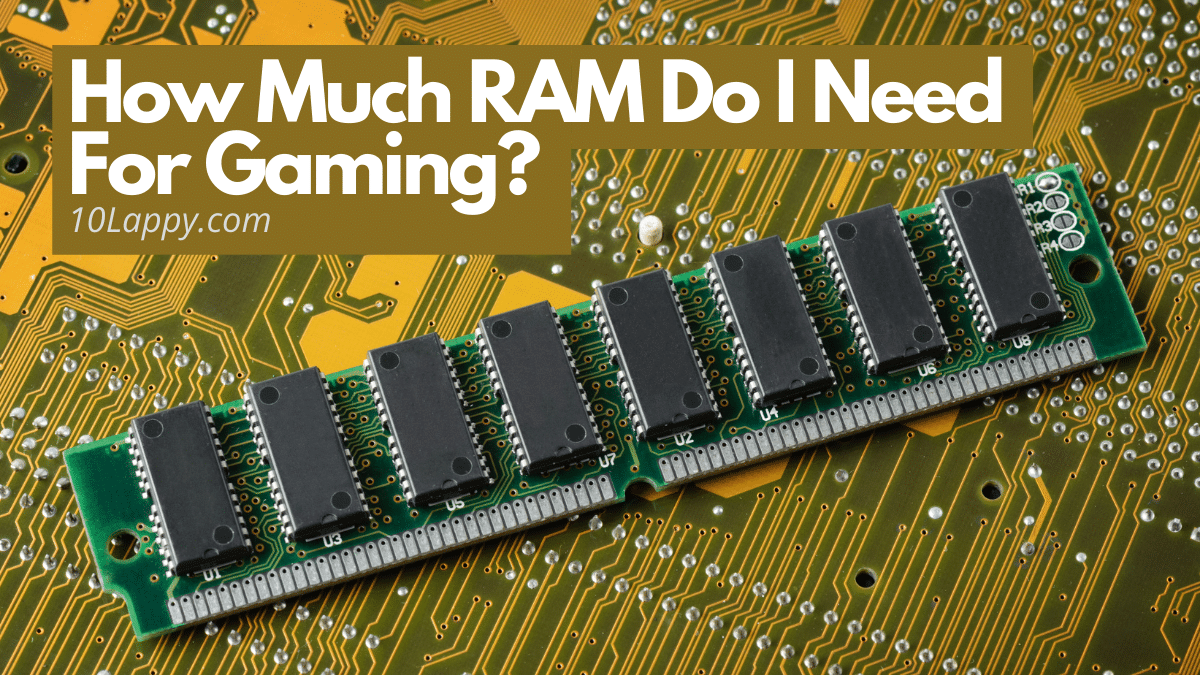
RAM, short for Random Access Memory, is the fast temporary workspace your laptop uses while it is running. When you launch a game, the parts of the game you are about to need are loaded from storage into RAM, because reading from RAM is far faster than reading from a drive.
The processor and the graphics card then work from that data. When you close the game, that temporary data is cleared.
That is why a slow drive and too little RAM feel different. A slow drive makes loading screens longer. Too little RAM makes the game itself stutter, because when RAM fills up, Windows starts moving data to the drive instead, using a paging file as emergency overflow.
A drive, even a fast SSD, is far slower than RAM for this job, so the game pauses briefly while data is fetched back. Players usually describe this as stuttering, hitching, or sudden frame drops that do not match what the graphics card should be able to do.
RAM does not work alone. The processor decides what happens, the graphics card draws the picture, and storage holds the game when it is not running. Adding RAM will not fix a weak graphics card, and it will not turn a slow processor into a fast one.
But if RAM is the bottleneck, it is often the cheapest and most noticeable upgrade available, because it removes the constant swapping to the drive that causes those hitches.
It also helps to separate two kinds of memory that are often confused. System RAM is the memory we are talking about in this guide. VRAM, or video memory, sits on the graphics card itself and holds textures and frame data for the picture. A laptop with a dedicated graphics card has both. To check the VRAM figure on your own machine, see our guide to how to check VRAM on your laptop.
A laptop with integrated graphics, where the graphics processor shares the main memory, does not have separate VRAM, so its graphics use part of the system RAM. That makes the total amount even more important on integrated graphics machines, because the game and the graphics are sharing one pool.

How Much RAM Do I Need for Different Types of Games?
The honest way to answer this question is to look at what publishers actually ask for, not at forum opinions. Requirements have risen steadily, and a figure that was generous a few years ago is now the minimum for some titles.
Start with the operating system itself. Microsoft lists 4GB of RAM as the minimum for Windows 11. That is the floor for Windows to install and run at all. It is not a gaming recommendation.
In practice, Windows plus its background services, a game launcher, and a couple of everyday apps can easily use several gigabytes before a game even loads. That is why a machine that technically meets a game’s minimum can still feel cramped: the minimum assumes very little else is running.
Baldur’s Gate 3, from Larian Studios, lists 8GB as its minimum and 16GB as its recommended amount, with an SSD required.
That is a useful anchor, because it is a large, detailed game that many people play on mid range laptops, and its recommended figure matches what most guides suggest for current gaming in general.
Cyberpunk 2077 shows how requirements climb with settings. CD PROJEKT RED’s current requirements, updated for Update 2.0 and the Phantom Liberty expansion, list 12GB as the minimum, 16GB as recommended, and 20GB for the ultra tier, again with an SSD required. Notice that 8GB does not even meet the minimum for this game any more.
A player with 8GB may still get the game to run in some cases, but they are below what the publisher supports, and stuttering is the likely result.
Starfield makes the same point even more bluntly. Bethesda lists 16GB at both the minimum and the recommended tier. There is no 8GB tier to fall back on.
If a game you want to play lists 16GB as its minimum, then 16GB is your floor, not your target, and you need to think about what else will be running alongside it.
Light games tell a different story. Esports titles, indie games, and older titles often list 4GB or 8GB, and they genuinely run well on that amount, because their worlds are smaller, their textures are simpler, and they load less data at once.
If that is all you play, 16GB still makes sense as a purchase, because it costs little extra and covers the occasional bigger title, but 8GB is not automatically a bad choice for this group.
The pattern to take away is simple. Minimum specifications describe the lowest setup the publisher will support, usually at low settings with little else running. Recommended specifications describe a comfortable experience at the settings most players actually use.
When you shop, aim for the recommended figure of the most demanding game you plan to play, then add headroom for everything else you run. That is how you avoid buying RAM twice.
Is 8GB of RAM Enough for Gaming?
8GB is enough for light gaming and for older games, and it is not enough for most current demanding games. Both halves of that sentence matter, because the advice you read online usually only gives you one of them.
On the plus side, 8GB covers esports titles, indie games, browser based games, and many games from a few years ago, provided you keep background apps to a minimum. If your laptop has 8GB and you mainly play those titles, you do not need to rush out and upgrade.
Close the browser, close extra launchers, and the machine will do the job.
The problem starts with current games. As the requirements above show, several major titles now list 12GB or 16GB as a minimum. On an 8GB machine, Windows and the game together exceed what is available, so the system leans on the drive.
The result is the classic symptom of too little RAM: the game loads, the menus look fine, and then the frame rate drops sharply whenever you move into a new area, because new data has to be fetched while old data is swapped out.
Lowering texture quality can help, because smaller textures use less memory, but it does not fix the underlying shortage.
8GB is also a poor choice for a new laptop in 2026 if you plan to keep the machine for several years. Games are not getting smaller, and the next game you fall in love with may list 16GB as its minimum.
If the laptop you are buying has soldered RAM that cannot be upgraded, which is common on thin and light models, buying 8GB locks in that limit for the life of the machine. Check the maker’s specifications before you buy, and treat upgradability as part of the decision, not as an afterthought.
The one situation where 8GB is a genuinely sensible buy is a tight budget laptop used mainly for light games, study, and everyday work, where the money saved goes towards a better processor or a solid state drive.
Even then, buy it as two 4GB sticks rather than one 8GB stick where you have the choice, because dual channel mode, explained below, gives a real speed benefit at no extra cost.
That logic is exactly how a tight budget gaming laptop under $300 is put together, with 8GB in one slot and a free slot for the matching second stick.
Is 16GB of RAM Enough for Gaming?
For most gamers, yes. 16GB is the current sweet spot, and the publisher requirements explain why. It meets the recommended specification of Baldur’s Gate 3 and Cyberpunk 2077, and the minimum and recommended specification of Starfield.
It leaves room for Windows, a game launcher, a voice chat app, and a browser tab or two, without constantly pushing into the paging file.
16GB also ages better than 8GB. A laptop bought with 16GB today is unlikely to be held back by RAM alone for the next few years of mainstream gaming, even if individual demanding titles benefit from more. It is also the amount where the price is sensible.
The step from 8GB to 16GB on a new laptop is usually modest, and on a desktop or an upgradeable laptop, a 16GB kit is one of the cheapest meaningful upgrades you can buy.
There are limits, and it is worth naming them plainly. 16GB can feel tight if you stream while you play, record gameplay at high quality, run a second monitor full of browser tabs, or play heavily modded games.
It can also feel tight on a laptop with integrated graphics, because part of that 16GB is shared with graphics, leaving less for the game and Windows. In those cases, 32GB is the better buy, and the next section explains why.
For a laptop you cannot upgrade later, 16GB is the minimum sensible choice for gaming in 2026. It is the point where you stop worrying about RAM for most titles and can focus your budget on the graphics card and the processor, which matter more once RAM is no longer the bottleneck.
Is 32GB of RAM Better for Gaming?
32GB is better for demanding setups, and it is wasted money for light ones. The difference is entirely about what you actually run at the same time.
You will benefit from 32GB if you play large open world games at high settings, especially at 1440p or 4K, where higher resolution textures use more memory.
You will benefit if you stream or record while you play, because streaming software, a browser with a stream dashboard, and the game all draw from the same pool.
You will benefit if you play simulation games or heavily modded games, where mods and large data sets can push memory use far beyond the base game’s requirement. And you will benefit if your laptop is also your work machine, and you switch between a game, a video call, and heavy apps without closing anything.
You will not see a benefit from 32GB if you play light titles and close everything else while you play. Unused RAM does not make a game faster. A game that uses 10GB will run the same on 16GB and on 32GB, provided nothing else is competing for memory.
Buying 32GB for that use is money that would have been better spent on a better graphics card, a larger SSD, or a better screen.
There is one more reason 32GB makes sense on a laptop you cannot upgrade: headroom for the future. If you keep a laptop for five years, the games at the end of that period will ask for more than the games at the start.
Buying 32GB now on a soldered machine is insurance against that creep, and it is cheaper than replacing the whole laptop early.
If the laptop is upgradeable, though, there is less urgency: you can start at 16GB and add another 16GB later if you ever need it, provided you match the new stick to the old one.
If you do buy 32GB, buy it as two matched 16GB sticks, not as a single 32GB stick. The dual channel benefit described below applies at every size, and a single stick setup gives away speed for no saving.
Do I Need 64GB of RAM for Gaming?
Almost certainly not, if gaming is all you do. 64GB is for heavy multitasking and professional work that happens to share a machine with gaming, not for gaming itself.
The cases where 64GB makes sense are specific. Video editing with large projects, 3D rendering, running virtual machines, heavy software development, or large scale simulation work can each use tens of gigabytes on their own.
A player who edits video, streams, and games on one machine may genuinely use more than 32GB across all of those tasks at once. Heavily modded games with very large mod lists can also push past 32GB, though this is the exception rather than the rule.
For ordinary gaming, even at 4K with high settings, 64GB will sit mostly empty, and the money is better spent elsewhere. A faster graphics card, a larger SSD, or a better cooling setup will improve your gaming experience far more than RAM you never use.
Our guide to how to keep a gaming laptop cool is worth reading alongside this one, because heat, not RAM, is often what holds a gaming laptop back once memory is sufficient. Similarly, if your laptop runs hot in general, our guide to how to stop your laptop from overheating covers the checks that matter.
The practical test is simple. Open Task Manager while you play your most demanding game with your normal apps running, and look at how much memory is actually in use. If you never get near your total, you do not need more.
If you regularly sit above 80 percent and see stuttering, an upgrade is worth considering. Do not buy 64GB on a guess.
Does RAM Speed Matter More Than RAM Size?
Size matters first, speed matters second. A laptop with enough slow RAM will beat a laptop with too little fast RAM every time, because the penalty for running out of memory, constant swapping to the drive, is far larger than the penalty for slightly slower memory.
Once you have enough RAM, speed and configuration start to matter. The most important configuration point is dual channel mode. RAM works faster when it is installed as two matched sticks, one in each channel, than as a single stick of the same total size, because the processor can read from both sticks at once.
The practical rule is simple: two 8GB sticks beat one 16GB stick, and two 16GB sticks beat one 32GB stick. If your laptop has two slots and only one is filled, adding a matching second stick is often the best value upgrade available.
Speed itself, measured in megahertz or megatransfers per second, makes a smaller difference for most gamers than capacity or dual channel mode. Faster RAM can help in processor heavy games and on integrated graphics, where graphics share system memory, but the gain is modest compared with fixing a capacity shortage or a weak graphics card.
Do not pay a large premium for the fastest kit if that money could buy more capacity or a better graphics card instead.
The generation matters mainly because it decides what fits your laptop. DDR4 and DDR5 are not interchangeable, and a laptop built for one cannot take the other. DDR5 is the current generation on new laptops, and it runs at higher speeds than DDR4, but you cannot upgrade a DDR4 laptop to DDR5 by swapping sticks. Our DDR4 vs DDR5 laptop comparison shows where the newer standard actually helps and where it does not.
Check your laptop’s specifications or the existing stick’s label before buying anything, and match the generation, speed, and timings as closely as you can to what is already installed. Mixing different speeds usually works, but the whole set runs at the speed of the slowest stick.
One more practical point: many thin laptops have RAM soldered to the board, with no slots at all. On those machines, the amount you buy is the amount you keep, so the decision at purchase time matters far more than on an upgradeable laptop.
If you are choosing between a soldered 16GB model and an upgradeable 16GB model at a similar price, the upgradeable one gives you an option later that the soldered one never will.
How Do I Check How Much RAM My Laptop Has?
Checking takes less than a minute, and it is worth doing before you buy anything or blame RAM for a problem that has another cause.
On Windows 11, press the Windows key and I together to open Settings, then choose System, then About, and look for the Installed RAM line under Device specifications. That tells you the total. For more detail, press Ctrl, Shift, and Esc together to open Task Manager, choose Performance, then Memory.
That screen shows the total, the speed, the number of slots used, and the form factor, which tells you whether the memory is a laptop SODIMM stick or soldered. It also shows how much is currently in use, which is the figure that matters when you are deciding whether you need more.
On a Mac, choose Apple menu, then About This Mac, and read the Memory line. Apple Silicon Macs have unified memory shared between the processor and graphics, and it cannot be upgraded after purchase, so the amount you choose at checkout is permanent.
That makes the same logic apply even more strongly: if you plan to game on a Mac, buy more memory than you think you need today, because there is no later upgrade.
The most useful check is not the total, but the usage while you play. Open Task Manager, start your most demanding game with your normal apps running, play for ten minutes, then switch back and look at the Memory figure. If usage sits comfortably below your total, RAM is not your problem.
If it sits at or near the total, and the game stutters when you move into new areas, RAM is a strong suspect.
Also check the processor and graphics figures on the same screen: if the graphics card is at 100 percent while RAM sits at half, the graphics card is the bottleneck, not the memory. If your processor is the bottleneck, our guide to how to reduce CPU usage while gaming covers the steps that help there.
What Are the Signs I Need More RAM?
Too little RAM has a recognisable pattern, and it is different from a weak graphics card or a slow drive. Learning the pattern saves you from buying an upgrade that does not help.
The clearest sign is stuttering that appears when you move into a new area, open a new map, or switch between apps, rather than a consistently low frame rate everywhere. A weak graphics card gives you low frame rates all the time.
A RAM shortage gives you smooth play punctuated by hitches, because the system is swapping data to and from the drive.
Long loading screens on their own point more at storage, so if loading is your only complaint, check your drive first: our guide to how much storage do I need on my laptop helps you work out whether capacity or drive type is the issue there.
Other signs include apps closing or crashing when you switch between a game and a browser, Windows warning you that memory is low, and the laptop feeling sluggish for a while after you close a game, while it clears the backlog.
On a laptop with a hard drive rather than an SSD, these symptoms are worse, because the paging file lives on a slow drive, which is another reason an SSD should be non negotiable on a gaming laptop in 2026.
Before you buy, run the usage check described above. It turns a guess into a number. If usage never approaches your total, more RAM will not help, and the money is better spent on the component that actually sits at 100 percent while you play.
How Do I Choose RAM for a New Gaming Laptop?
Work through these steps in order, and you will end up with a sensible number rather than a guess.
Step 1: List the most demanding game you actually plan to play, and look up its published recommended specification, not just its minimum. That recommended figure is your starting point. If the game lists 16GB recommended, start at 16GB.
Step 2: Add headroom for everything else you run. If you stream, record, keep a browser open, or use voice chat while you play, add a step: 16GB becomes 32GB. If you play with everything else closed, the recommended figure on its own is fine.
Step 3: Check whether the laptop can be upgraded. If the RAM is soldered, buy one step more than you think you need, because you cannot fix a shortage later. If it has two slots and you can upgrade, you can start at the recommended figure and add more later.
Step 4: Buy matched sticks. Two sticks of the same size, speed, and generation, installed as a pair, give you dual channel mode. A single stick of the same total size does not.
If the laptop ships with one stick and a free slot, adding a matching second stick is the cheapest meaningful upgrade you can make.
Step 5: Do not overspend on speed at the expense of capacity. Once you have enough RAM in dual channel mode, put any remaining budget towards the graphics card, the SSD, cooling, or a better screen. Those will change how games feel far more than a small speed increase in RAM.
One final caution applies to buying used or older laptops. A machine with 8GB that cannot be upgraded may look like a bargain, but if the games you want list 12GB or 16GB as a minimum, that bargain becomes a machine that stutters from day one.
Always check the recommended specification of the games you want, and the upgrade options of the machine you are buying, before you pay.
Frequently Asked Questions
Is 16GB RAM enough for gaming in 2026?
Yes, for most gamers. 16GB meets the recommended specification of most current games, including Baldur’s Gate 3 and Cyberpunk 2077, and leaves room for Windows and a few background apps. It is the sweet spot for 1080p gaming. Move to 32GB if you stream, record, play at 1440p or 4K with high resolution textures, or run a lot of apps alongside your game.
Is 8GB RAM enough for gaming?
Only for light, older, or esports titles, and only if you keep background apps to a minimum. Several current games now list 12GB or 16GB as a minimum, so 8GB is below the supported specification for those titles and is likely to cause stuttering. 8GB is a poor choice for a new laptop you cannot upgrade, because you cannot fix the shortage later.
Does more RAM increase FPS?
Only if RAM was the bottleneck. If your system was running out of memory and swapping to the drive, adding RAM removes the stuttering and can raise the lowest frame rates noticeably. If RAM was already sufficient, adding more will not raise your frame rate, because the graphics card and processor are then the limiting factors. Check Task Manager while you play before you buy.
Is 32GB RAM overkill for gaming?
For light gaming, yes. For demanding open world games, streaming, recording, or heavy multitasking, no. 32GB is the sensible choice for a streamer, a creator, or a player of demanding titles at higher settings, and it is good insurance on a laptop with soldered RAM. It is wasted money only when the extra memory never gets used.
Can I mix different RAM sticks in my laptop?
You can in most cases, but it is not ideal. Mixed sticks usually run at the speed and timings of the slowest stick, and mismatched sizes can disable dual channel mode for part of the memory. For the best result, buy a matched pair of the same size, speed, and generation, and check your laptop’s specifications for the maximum it supports before you buy.
The Verdict
For most gamers, 16GB is the answer. It covers the recommended specification of most current games, handles Windows and a few background apps without strain, and costs little extra over 8GB.
Choose 8GB only for light titles on a tight budget, and only if you understand that several current games already list more as a minimum.
Choose 32GB if you play demanding games, stream or record, or run a lot alongside your game, and choose it from the start if your laptop’s RAM cannot be upgraded later. Choose 64GB only if heavy work, not just gaming, genuinely uses it.
Whatever number you pick, buy it as two matched sticks, check the published requirements of the games you actually play, and check your usage in Task Manager before you spend money on an upgrade.
RAM is one of the few laptop choices that is easy to get right, as long as you work from your own games and your own numbers instead of someone else’s opinion.